FPC Analysis Report
FPCs are a silent revolution in Maharashtra's horticulture sector, where small farmers collectively pool in savings, determine prices, and minimize dependence on middlemen. While more than 1,000 FPCs are registered with the state, still less than 30% of them function efficiently on various parameters of aggregation, smallholder inclusion, and financial viability. These FPCs can raise farmers' price realization by 20–30% and credit access by 40–50%, governance and infrastructure gaps persist.
When we talk about Farmer Producer Companies (FPCs), it's easy to get lost in acronyms, subsidies, and policy papers. But behind those terms are real stories of small farmers pooling their savings, collective decisions on prices, and a quiet shift from dependency on middlemen to shared ownership of markets.
Small and marginal horticulture farmers face fragmentation, weak bargaining power, and poor credit access. FPCs bridge these gaps through aggregation and institutional credibility; as of now, Maharashtra has around 1,056 FPOs with 3.2 lakh members and INR 777 crore revenue. About 90% received support from SFAC or NABARD.
Here are some analytical findings about FPC's:
Governance and leadership empowerment are strongly related to turnover as well as satisfaction of the farmers. Most FPCs are constrained by weak participation, low transparency, and lack of professional management.
Average price increase: +25–30%. Farmers claim faster payments and stronger bargaining positions.
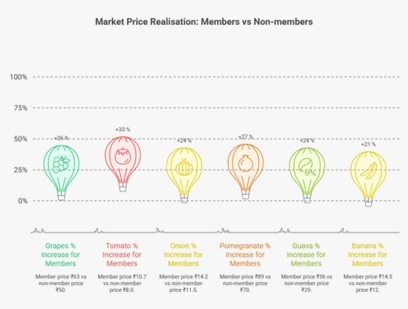
Market Price Realisation: Members vs Non-members
Only 41% of active FPCs had working-capital lines; utilization averaged 54%. FPCs with audited accounts were 2.4x likelier to get loans. Membership roughly doubles access to formal credit.
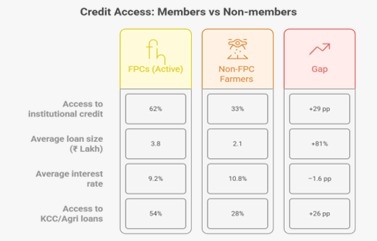
Credit Access: Members vs Non-members
Despite promising results in income uplift and credit access, most FPCs in Maharashtra still struggle due to a combination of internal weaknesses and external ecosystem failures. Many are promoted through short-term, subsidy-driven programs without sustained handholding, resulting in weak governance, limited professional management, and lowmember participation. Nearly 70% of FPCs operate at a small scale with fewer than 500 members and turnovers below ₹50 lakh restricting their ability to invest in infrastructure, aggregate produce, or negotiate with buyers. Inadequate cold storage, grading, and packhouse facilities lead to quality losses, while dependence on APMC markets exposes FPCs to competition from cash ready traders. Access to finance remains constrained, withv only 41% of active FPCs receiving working capital loans, often further limited by procedural hurdles. Fragmented policy implementation, low inclusion of smallholders and women, and weak social cohesion dilute collective strength. Most critically, many FPCs function more as social collectives than business enterprises, remaining grant-dependent and lacking the market orientation needed to transition into sustainable agri-enterprises.
The experience of FPCs in Maharashtra underscores a few decisive lessons. Profitability is ultimately shaped by the “3C” formula, adequate capital, strong internal capacity, and reliable market connections. Evidence also shows that female led FPCs demonstrate stronger repayment discipline, though they require greater institutional support further resulting transparency in data and operations significantly improving access to buyers and formal finance. When these conditions align, FPCs have delivered tangible outcomes: 32–67% increases in farmer incomes, nearly 30% better price realization, and 40–50% higher access to credit. Realizing their full potential. However, it depends on sustained capacity building and ecosystem level reforms. More than economic entities, well-functioning FPCs serve as instruments of dignity, ownership, and rural transformation. Scaling such models across Maharashtra will require coordinated action by government, financial institutions, and private partners so that FPCs can move from isolated successes to a scalable and sustainable pathway for empowering small and marginal farmers.

