Spatio-Temporal Analysis of Groundwater Depletion and Effectiveness of Existing Recharge Efforts(By Sagar Adsul PARC)
Total Views |


Background
Despite Maharashtra being faced with a severe groundwater shortage, approximately 60% of irrigated farmland and 85% of rural drinking water needs are met by groundwater; some blocks are deemed over-exploited, with extraction significantly exceeding natural recharge. Despite significant investments in recharge infrastructure over the last two decades, groundwater stress remains unresolved. Thousands of check dams, percolation tanks, and recharge wells have been constructed,but their impact on long-term water availability has been uneven.
Over 25,000 villages out of 44,778 were declared drought-free by the Jalyukt Shivar Abhiyan alone, yet summer water scarcity remains severe, and water levels are still dropping in key areas 2 . This disparity between hydrological results and infrastructure expenditure highlights serious problems with existing methods. In traditional water management, the number of structures has taken precedence over maintenance, geological compatibility, and strategic placement. To determine where stress is most severe, how it has changed, this is a primary analysis of 25 years of groundwater monitoring data from 2,037 observation wells across Maharashtra.
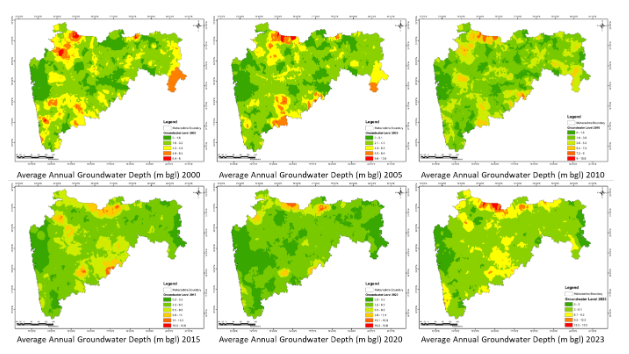
Analysis of Groundwater level changes from the year 2000
The various phases are shown by analyzing pre-monsoon groundwater depths when aquifers are under the most stress. At the same time, the dataset captures long-term trends at 5-year intervals, but it does not fully account for annual spikes during drought years. With average depths of roughly
1. Mandavkar, Groundwater Situation in Maharashtra-Rajiv Gandhi Institute For Contemporary Studies.
2. Jalyukt Shivar Yojana.
3. Kuruva et al., “Quality Controlled, Reliable Groundwater Level Data with Corresponding Specific Yield over
India.
4. Kuruva et al., “Quality Controlled, Reliable Groundwater Level Data with Corresponding Specific Yield over
India.
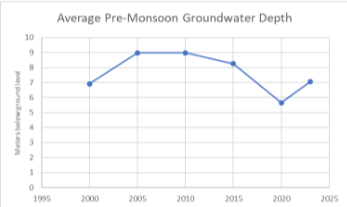
6.92m, the early 2000s demonstrated relative steadiness. But by the mid-2000s, there had been a concerning decline, with a depletion rate of 0.41m per year, reaching 8.98m by 2005. The percentage of critical wells (those deeper than 10m) increased from 17.7% to 33%. Insufficient monsoons and agricultural expansion of water-intensive crops like sugarcane accompanied this.
Despite multiple recharge measures, stress remained consistently high between 2005 and 2015, indicating that these efforts only kept up with extraction rather than addressing deficits. The average depths stabilized between 8.3m and 9.0m, and 27 to 33% of wells exhibited critical stress, an expensive equilibrium based on persistent overexploitation. Data from after 2015 indicates a slight recovery, with 2023 depths falling to 7.06m, which is close to levels seen in the early 2000s. This is likely due to cumulative watershed modifications, favorable monsoons, and potential decreases in extraction. Remarkably, 3.2% of regularly monitored wells continued to deplete, whereas 46.3% of wells exhibited recovery surpassing 0.5m.
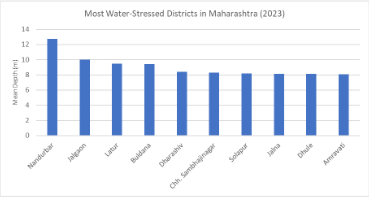
A district-level study reveals critical geographical heterogeneity. With depths of 8-12m in 2023, Nandurbar, Jalgaon, Latur, Buldhana, and Dharashiv continue to be chronic stress zones. These districts are similar in that they have hard-rock aquifers with limited storage capacity or are rain-shadowed. An average depth of 12.7m in Nandurbar indicates a severe and ongoing groundwater crisis. On the other hand, Ratnagiri, Sindhudurg, and portions of Pune demonstrate stability or improvement due to increased rainfall and efficient watershed management, highlighting the fact that groundwater solutions cannot be consistent.
Challenges and Root Causes: Why Recharge Efforts Fall Short
The persistence of groundwater stress, despite extensive infrastructure creation, suggests deeper systemic constraints that limit the effectiveness of many interventions. The Deccan basalt geology of Maharashtra has little intrinsic porosity, and groundwater is stored in cracks and weathered areas 5 . Many recharge structures are built over impermeable zones or areas cut off from the strained aquifers downstream, due to inadequate hydrogeological research. In addition to failing to replenish serving wells, a misplaced check dam may cause waterlogging.
| Category | Number of Wells | Percentage Change |
|---|---|---|
| Significant Recovery (>2m improvement) | 132 | 24 |
| Moderate Recovery (0.5-2m improvement) | 123 | 22.3 |
| Stable (±0.5m) | 113 | 20.5 |
| Moderate Depletion (0.5-2m decline) | 91 | 16.5 |
| Severe Depletion (>2m decline) | 92 | 16.7 |
Table 1 Groundwater Level Changes Across Maharashtra (2000-2023)
5 Rai et al., “Exploration for Groundwater in the Basaltic Deccan Traps Terrain in Katol Taluk, Nagpur District,
India.”
There is little funding for maintenance, despite the fact that over 40% of check dams needdesilting within 5 years. Maharashtra's estimated 3.5 million agricultural borewells are still expanding, and the water-stressed districts have seen a 30–50% increase in well density over the past 20 years, driven by high-capacity submersible pumps that extract groundwater faster than it can be replenished by recharge.
The issue is made worse by the persistence of water-intensive crops in groundwater-stressed areas. Sugarcane, which accounts for only 4% of cropped land but uses more than 70% of irrigation water, persists in water-scarce areas because of the political economy of sugar cooperatives. Distorted procurement policy incentives are shown in the production of paddy in the unsuitable Vidarbha and Marathwada regions. The majority of programs lack post-
implementation evaluation and baseline monitoring, thereby eliminating feedback channels for improvement.