Research in the Humanities: A Pathway to Social Transformation and Sustainable Development
Total Views |


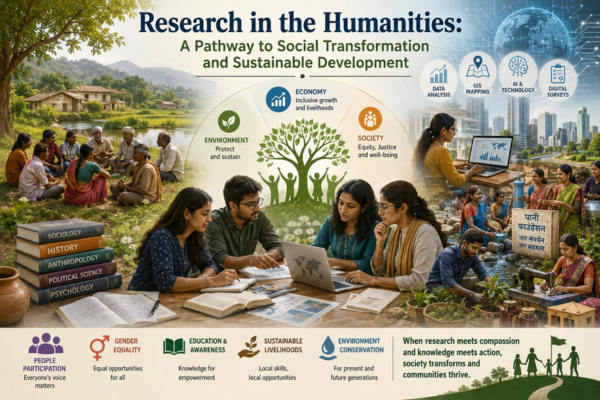
The study of the humanities is not merely about obtaining an undergraduate or postgraduate degree; it is a meaningful process of understanding society, critically examining its challenges, and providing direction for social transformation. The humanities offer countless opportunities for research. However, such research should not remain confined to libraries, dissertations, or academic publications. It should contribute directly to the development of society by deepening our understanding of social issues, identifying practical solutions, and inspiring movements for positive social change.
Many social initiatives begin with a sensitive human experience or an emotional commitment to a cause. While compassion often serves as the starting point, expanding the scope of such work, measuring its impact, and ensuring its long-term sustainability require systematic research. Thus, socially relevant research is not merely an academic exercise; it is a powerful instrument for holistic social development.
No significant social transformation is achieved by an individual working alone. It requires people united by a shared vision and purpose. Research in the humanities has the capacity to nurture socially conscious, sensitive, and thoughtful individuals. It not only studies social problems but also brings together diverse sections of society and provides direction for collective action.
Today, society faces complex mental, social, economic, and environmental challenges. Rapid technological advancement, the overwhelming flow of information, changing lifestyles, and widening social inequalities are influencing both individuals and communities in profound ways. These challenges cannot be understood through superficial observation alone. Researchers must examine the underlying social processes, human behaviour, value systems, and policy gaps that shape these issues.
Sustainable Development has become one of the most important concerns of our time. It is impossible to achieve sustainable development without balancing environmental protection, economic progress, and social justice. Many developed nations have adopted different development models that attempt to achieve this balance. Studying these experiences and adapting them to India's unique social and cultural context is an important responsibility of researchers.
Society is not merely a collection of individuals; it is a dynamic system shaped by continuous social processes such as cooperation, conflict, adaptation, participation, leadership, and change. Therefore, students of the humanities must understand these process dynamics. At the same time, they should be equipped to use modern technologies such as Artificial Intelligence (AI), data analytics, digital surveys, Geographic Information Systems (GIS), and data visualization. Knowing technology is important, but using it effectively to bring about positive social transformation is even more important.
The concept of Smart Cities has gained widespread attention, but an equally important question remains: Are our villages becoming smart, prosperous, and sustainable? This itself is a significant research question. Development should not be measured merely by roads, buildings, or digital infrastructure. True development is reflected in strong local economies, employment generation, quality education, accessible healthcare, environmental conservation, and a better quality of life for people.
Traditional rural India was supported by the Balutedar system, a remarkable skill-based socio-economic structure in which practical knowledge and occupations were passed down through generations. These traditional skills sustained local economies and strengthened village self-reliance. Research should explore whether these indigenous skills can be combined with modern technology and entrepreneurship to create new employment opportunities within villages. Instead of migrating to cities, can young people build dignified and sustainable livelihoods while remaining in their own communities? This is one of the most relevant questions for contemporary research.
Similarly, there is a need to examine how the concept of development has evolved in India since the early 1980s. Liberalization, globalization, technological progress, migration, and changing rural-urban relationships have significantly reshaped Indian society. Research on these transformations can help develop more realistic and inclusive models of future development.
Development can never be truly successful without people's participation. Several community-based organizations have demonstrated that watershed development, organic farming, and similar initiatives become sustainable when local communities actively participate. Villagers contribute through voluntary labour, planning, decision-making, and implementation. As a result, these initiatives become community-owned movements rather than government-driven projects. This clearly demonstrates that public participation is the foundation of sustainable development.
Different sections of society perceive development in different ways. A woman often understands the value of household water supply through her daily experiences and responsibilities. Women and senior citizens can provide valuable perspectives on sanitation and the importance of household toilets. Adolescent girls have unique concerns regarding access to safe sanitary pads and environmentally responsible disposal systems. Similarly, when men receive local employment opportunities based on their skills, migration decreases, families become economically stable, and greater attention is given to village development. Therefore, the voices of women, men, youth, children, and senior citizens must all be included in the development process.
Agriculture continues to be central to India's development. However, agriculture should not be viewed only in terms of crop production. It must be integrated with food processing, value addition, dairy farming, livestock, agri-tourism, storage, marketing, and rural entrepreneurship. Providing training and creating employment opportunities in these sectors can revitalize rural economies and reduce migration.
Agriculture also faces several structural challenges, including climate change, water scarcity, rising production costs, market volatility, indebtedness, and policy limitations. Addressing these issues requires comprehensive and interdisciplinary research. The true purpose of research is not merely to describe problems but to identify practical, sustainable, and socially acceptable solutions.
Another important question that deserves attention is the changing nature of relationships among farmers. In the past, farmers regularly met, exchanged ideas, and collectively discussed solutions to common problems. With the increasing use of technologies such as Artificial Intelligence (AI) and digital platforms, are farmers gradually becoming more isolated from one another? While technology has made information more accessible, it is equally important to examine whether it has weakened traditional community interactions and collective decision-making. This too is an important area for future research.
When researchers engage directly with society, research acquires a deeper human dimension. Understanding people's struggles, working to improve their lives, and contributing to collective well-being transform research from a purely academic activity into a social and ethical responsibility. Such engagement nurtures empathy, social commitment, and inner satisfaction. At this stage, research reaches a philosophical and even spiritual dimension, where knowledge becomes a means of serving humanity rather than merely achieving academic success.
The National Education Policy (NEP) 2020 emphasizes connecting education with society and promoting multidisciplinary, community-oriented learning. In this context, research in the humanities has a vital role to play. By integrating socially relevant research, indigenous knowledge, appropriate use of modern technology, community participation, and sustainable development, research can move beyond university campuses and become a catalyst for social transformation, inclusive development, and nation-building.
Ultimately, the objective of research in the humanities is not simply to complete a dissertation or earn a degree. Its true purpose is to understand society, guide society, and work alongside communities to create sustainable and inclusive transformation. When research becomes socially relevant, ethically grounded, and action-oriented, it transcends academic boundaries and becomes a powerful force for democratic knowledge creation, human development, and the building of a just, sustainable, and developed nation.