Enhancing Sangli’s Viticulture and Supply Chain Integration to StrengthenGlobal Export Standards(By Ruthika Saravanan PARC)
This study will conduct an in-depth analysis of farmers in Sangli, various elements of the supply chain, and ongoing agricultural experiments and innovations. The research will primarily focus on understanding the necessary steps, regulatory policies, and improvements required to maintain Global Export Standards.
Through quantitative comparisons, the study will identify key measures to stabilize quality rankings and explore innovative methods and technological interventions that can help reduce the rejection rate in agricultural exports.
By engaging in dialogues with farmers, supply chain traders, and export-sector experts, this discussion-based study aims to strengthen Sangli’s viticulture, making it more competitive and sustainable at the global level.
From a humanities perspective, this topic highlights the deep connection between culture, livelihood, and human development. Viticulture in Sangli is not merely an economic activity — it is a part of the region’s cultural identity, traditional knowledge systems, and social fabric. Studying it through the lens of humanities helps us understand how local practices, community cooperation, ethics of trade, and global interactions shape rural lives and influence sustainable development.
Persistent quality and compliance gaps
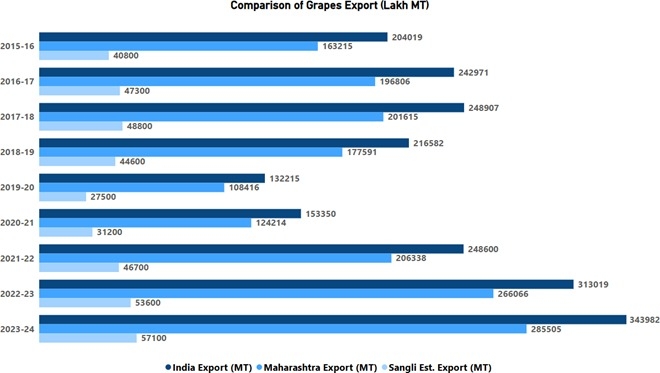
India’s grape export performance highlights the state’s critical role. In FY 2023-24, according to the Economic Survey referring to DGCIS, India exported approximately 3.43 lakh metric tonnes of grapes worth ₹3460 crore.
1 District Statistical Office, Sangli
2 Ministry of Agriculture & Farmer Welfare
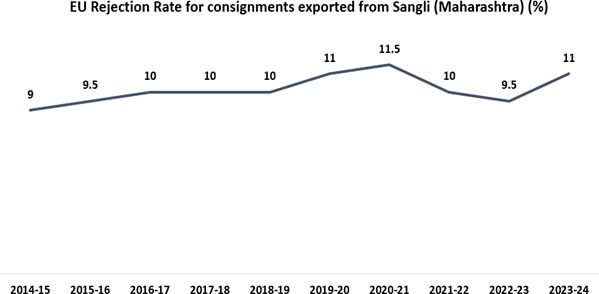
crore with Maharashtra’s export ranged between 80% and over 90% of the national volume (APEDA) and Sangli’s estimated share is around 57,100 MT assuming it roughly contributes about 20% of the state's export. However, this potential continuously undermined persistent quality and compliance gaps. For instance the estimated 10- 12% EU rejection rate for Indian consignments in recent years is a critical indicator of these gaps. The primary and well documented reason for these rejections has been the detection of pesticide residues exceeding the Maximum Residue Limits (MRLs) such as Chlormequat Chloride (CCC) a fact frequently cited in the APEDA’s and National Research Centre for Grapes reports.
The current viticulture practices in Sangali are characterized by a mix of traditional and semi modern techniques. The success and high yield are ultimately rooted in the inherent skill and innovative history of the farmer base of the region.
There are Sangli growers who have been directly involved in varietal development through clonal selection.
Farmers like Vasantrao Arve and Ramchandra Mali developed popular clones like ‘Tas-A-Ganesh’ and ‘Sonaka’ from the parent ‘Thompson Seedless’, showcasing a deep, practical understanding of viticulture according to academic research on the role of farmer-led innovation.
of Indian grape growers in breeding. However, this inherent skill is inconsistently applied across the entire production area leading to the quality disparities and rejection issues. Key issues include:
1.Irregular pesticides use: The core of viticulture enhancement challenge lies in adhering to the Mandatory Approved Chemicals List. Exporters and growers must use only the agrochemicals explicitly recommended and monitored by the National Research Centre for Grapes and APEDA. Critically, growers must strictly observe the Pre-Harvest Interval (PHI), the minimum time between the last pesticide application and harvest for every chemical used. Failure to adhere to PHI is the primary reason for Maximum Residue Limit breaches leading to rejections of consignments even when legally approved chemicals are used.
2.Inconsistent Management: limited soil testing and non-uniform canopy management reduce the quality consistency across farms.
3.Low international certification
Supply Chain Bottlenecks and the way forward
To unlock Sangli's export potential and align the supply chain to the make it globally competitive a proper strategy is necessary:
1.Viticulture enhancement: Adoption of Precision Irrigation and Integrated Pest Management along with spreading awareness of soil testing and nutrient management and strict adherence to pre- harvest residue testing is crucial.
2.Supply chain Integration: Investment in district level APEDA certified packhouses and cold storage clustered is essential. The standardized grading and packaging along with deployment of digital traceability systems linking farm level practices to export documentation.
3.Institutional Strengthening: Strengthening Framer Producer Organizations and cooperative is important. The success of the cooperative model in Maharashtra which has been proven to reduce rejection rates and increase farmer’s income could also be replicated. Government schemes like the Agriculture Export Policy 2018 and Cluster Development Programs can provide the necessary structural and financial support. The shift from a volume focus to quality driven export ready viticulture is directly supported by a significant economic incentive. Grapes that achieve the stringent MRL compliance and pass cold chain standards typically command a price premium that is 20-30% higher 3than those sold in the non-complaint domestic market. Furthermore, joining a well-managed FPO or cooperative can increase farmer income and is proven
to reduce rejection rates significantly allowing members to access better quality inputs and shared cold chain infrastructure making compliance a strong business case.
Overall, Sangli possesses favourable agro climatic conditions and an exceptionally capable farmer base through a foundation strength supported by its high yields and historical role in clone development. However, realizing its full global export competitiveness as mentioned above requires a shift from a focus on volume to quality driven export ready viticulture supported by a rigorously integrated, traceable and cold chain enabled supply chain.